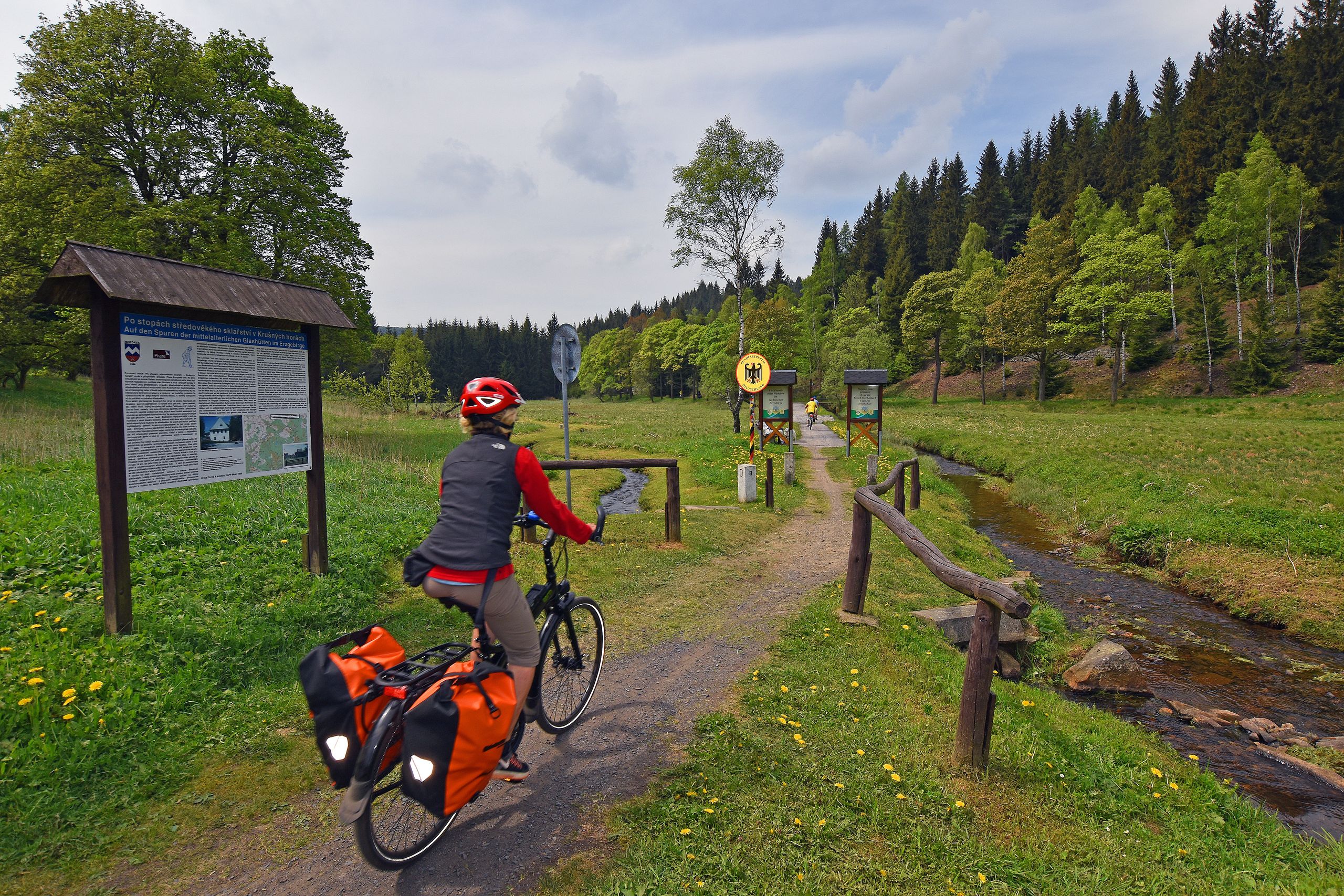
Blick auf 2 Radfahrer auf dem Mulderadweg an der Freiberger Mulde
Freiberger Mulde - Radfahren auf dem Mulderadweg

The Mulde Cycle Route connects diverse landscapes, vibrant cities and distinctive cultural regions over a distance of around 400 kilometres. Following the Zwickauer Mulde, Freiberger Mulde and Vereinigte Mulde rivers, the cycle route passes through five diverse tourism regions: 

  • the Vogtland
  • the Ore Mountains
  • the Chemnitz.Zwickau.Region
  • the Leipzig Region and 
  • the World Heritage Region Anhalt-Dessau-Wittenberg.

Each region has its own character: unspoilt low mountain landscapes, historic mining and craft towns, industrial heritage, magnificent castles, historic towns, wide river floodplains and important cultural monuments make the Mulde Cycle Route a particularly varied cycling journey. Take time for small detours, regional specialities and personal discoveries along the route.

The Mulde Cycle Route also crosses two borders. At the source of the Freiberger Mulde near Moldava, you start in the Czech Republic and cycle across the border into Germany. Further north, at the Vereinigte Mulde near Löbnitz, you cross from the Free State of Saxony into Saxony-Anhalt. The Mulde Cycle Route therefore connects not only three river branches, but also regions, federal states and countries – making their diversity a special experience.

Vogtland

 “Symphony of Nature”

Starting in Schöneck, the highest town in Vogtland, the Mulde Cycle Route leads through rolling upland landscapes via the Muldenberg Reservoir to Morgenröthe-Rautenkranz, where you can experience the fascination of space travel and space research. The town became known as the birthplace of Sigmund Jähn, who became the first German cosmonaut to travel into space in 1976.

The Ore Mountains

Ore Mountains Adventure Region

The Ore Mountains are crossed by both branches of the Mulde River. 

In the upper valley of the Freiberger Mulde lies the Ore Mountains/Vogtland Nature Park, surrounded by extensive forests. Following in the footsteps of mining, the route leads downstream from Holzhau, the former rafting town, to Rechenberg-Bienenmühle, known for its brewing culture, and on to Freiberg – the Silver Town, one of Europe's largest silver mining areas. 

The Zwickauer Mulde flows through the southern part of the Ore Mountains. Here, in Aue-Bad Schlema, you can follow the traces of industrial history. In the family-friendly town of Eibenstock, there is plenty to experience at Wurzelrudi's Adventure World.

Chemnitz.Zwickau.Region.

“Industry meets culture meets nature. A harmonious trio that ­inspires.”

Along the Zwickauer Mulde, you can explore a variety of romantic castles, such as Wildenfels Castle with its silk wallpapers in the “Blue Salon”, unique in Europe, or Rochsburg Castle with its chocolate manufactory. 

Pass through the Robert Schumann city of Zwickau, home to the heart of the German automotive industry. 

In the heart of the idyllic Mulde Valley, the Mulde Cycle Route leads beneath the impressive Göhren Viaduct to Amerika. 

There is plenty to experience around Rochlitz Hill, with its glowing red Rochlitz porphyry tuff, including rail Trabant rides and inflatable boat and canoe tours. At Rochlitz Castle, you can explore 800 years of architectural history using virtual reality.

The Leipzig Region

Castles I Lakes I Heathland I City

In the Leipzig region, the hills are left behind as you enter the flat floodplain landscapes of the Mulde meanders. 

Following the course of the Freiberger Mulde, the route passes through Roßwein and the boot town of Döbeln to the idyllic Cistercian monastery, “Kloster Buch”, and Mildenstein Castle. Located directly on the Mulde Cycle Route, the Leisnig Cultural Station is also well worth a stop for a break in the beer garden. 

Coming from the Zwickauer Mulde, the historic Renaissance Colditz Castle invites you to visit. 

Shortly afterwards, the two headwaters join together in Sermuth to form the Vereinigte Mulde. From here, you can cycle at a relaxed pace through the characteristic Mulde floodplains to the charming old town of Grimma. From Wurzen, the birthplace of writer Joachim Ringelnatz, whose work and life can be explored here through the Ringelnatz Trail, his birthplace and museum, the route continues by bike to the Dübener Heide, with its unique flora and fauna.

World Heritage Region 
Anhalt-Dessau-Wittenberg 

Finally, near Bad Düben, the cycle route leaves the state of Saxony and continues into the World Heritage Region Anhalt-Dessau-Wittenberg in Saxony-Anhalt. 

It passes right through the Goitzsche Lake Region, past the Mulde Reservoir and the Great Goitzsche Lake, with the Water Level Tower and the Bitterfeld Arc, landmarks of the city of Bitterfeld. 

The Mulde Cycle Route ends at the confluence with the Elbe near Dessau-Roßlau. Here, no fewer than three UNESCO World Heritage Sites line up in succession – the Bauhaus buildings, the Dessau-Wörlitz Garden Kingdom, and the Central Elbe Biosphere Reserve, which can be ideally combined on a UNESCO World Heritage tour.